

What if feeling unlike yourself during menopause doesn’t mean you’ve lost who you are, but that the roles, routines and expectations around you are changing? If you’re wondering how to deal with loss of identity during menopause, you don’t need to find one big answer or make a complete fresh start. Small steps can help you understand what feels different and what matters to you now.
You may be grieving changes to your body, confidence, work or family life, while hormonal shifts and everyday pressures leave you feeling unsettled. It’s understandable to miss the person you remember being, or to feel unsure what you want next. That deserves care, not self-criticism.
This guide explores why menopause can affect your sense of self and offers practical ways to reconnect with what matters, from revisiting interests to making room for rest and reflection. You’ll also find guidance on when to seek support. There’s no single route back to yourself. You can take thoughtful steps at your own pace.
Key Takeaways
- Identity disruption can feel like a shift in your self-image, roles or familiar patterns, and it won’t look the same for everyone.
- Menopause-related changes in identity may involve a mix of symptoms, changing roles and personal expectations, rather than one single cause.
- Discover how to deal with loss of identity during menopause through small, flexible steps that help you reconnect with what matters to you.
- If distress persists or disrupts daily life, speaking with a GP or qualified mental health professional can be a helpful next step.
- Feeling more like yourself may mean finding a new balance, not returning to exactly who you were before.
What does loss of identity during menopause feel like?
Feeling changed, uncertain or less at ease in your own life deserves attention, even if you can’t put a clear name to it. There’s no single menopause experience, and feeling unlike yourself doesn’t automatically mean something is wrong. Here, identity disruption means a perceived shift in your self-image, the roles you recognise as yours, or the familiar patterns that once helped you feel grounded.
It doesn’t mean you’ve permanently lost your identity. You may be questioning what still fits or trying to understand why familiar parts of life feel different. That can be unsettling, but it isn’t proof that the person you were has disappeared.
What might feeling unlike yourself look like?
For one person, it might mean feeling less confident at work; for another, having less patience at home, losing interest in a favourite pastime, or feeling uncomfortable in a role that once felt natural. Some notice a change in motivation or how they respond to their body. Others feel mostly steady, with only occasional moments of doubt. No single feeling proves that menopause, or a mental health condition, is the cause.
Brief uncertainty can come and go. If distress keeps returning, feels hard to manage, or begins to interfere with everyday life, take it seriously. This isn’t a diagnosis. It’s a reason to pause, notice what’s changed and consider whether support could help.
Why identity can feel unsettled during midlife
Menopause-related physical or emotional changes may overlap with disrupted sleep, changes in routine and pressures outside the body. Family responsibilities, work, relationships and cultural messages about ageing can all influence how you see yourself. Several factors may meet at once, so it isn’t always possible to separate one cause from another.
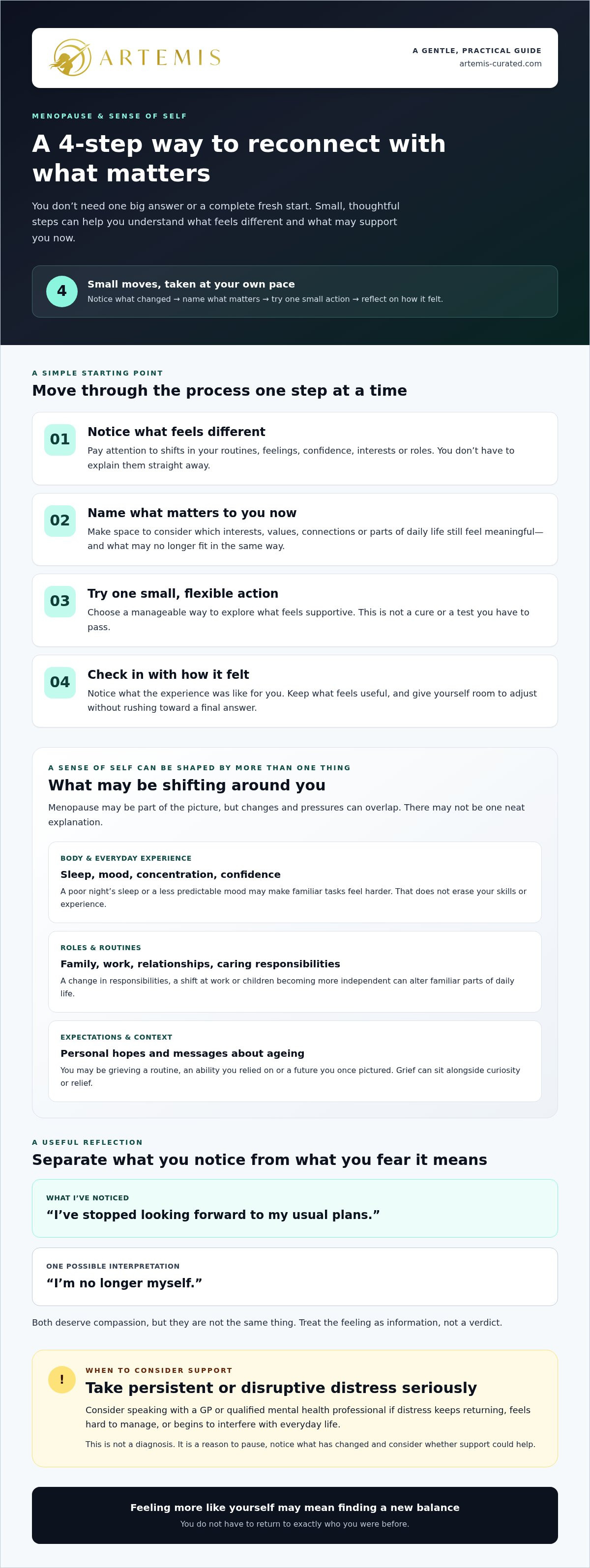
A general overview of menopause describes a range of stages and possible physical and psychological changes, but it can’t tell you what explains your individual experience. Try distinguishing what you’ve noticed from what you think it means. For example, “I’ve stopped looking forward to my usual plans” is an observation; “I’m no longer myself” is one possible interpretation. Both deserve compassion, but they’re not the same thing.
If you’re wondering how to deal with loss of identity during menopause, start by treating the feeling as information, not a verdict. You don’t need to force a quick answer about who you are now. Noticing what feels different is a thoughtful first step.
How menopause changes can affect your sense of self
A shift in identity rarely has one neat explanation. Changes in sleep, mood or concentration may coincide with new responsibilities, changing relationships and questions about what you expected midlife to look like. Menopause may be part of that picture, but it doesn’t explain every emotional or cognitive change. The mix of influences will differ for each person.
Menopause-related symptoms, shifting roles and personal expectations can overlap, making it hard to tell where one influence ends and another begins.
Body, mood, sleep and confidence
If poor sleep leaves you foggy the next day, or your mood feels less predictable, tasks you usually handle with ease may take more effort. You might then question your competence or feel less confident, even though a difficult stretch doesn’t erase your skills or experience. These links are worth noticing, but they don’t prove that menopause is the sole cause. If changes persist or concern you, note what you’re experiencing and discuss it with a healthcare professional.
For wider background, Navigating Menopause: A Curated Guide to Holistic Harmony offers context on the menopause transition. Reading about the subject can help you find language for what’s happening, without requiring you to fit your experience into a fixed pattern.
Roles, relationships and expectations
Self-image is shaped by more than health. A change in caring responsibilities, a shift at work, a relationship adjustment or children becoming more independent may alter the daily roles through which you’ve known yourself. You might also be grieving a routine, an ability you relied on, or a future you once pictured. That grief can sit alongside curiosity or relief. It doesn’t follow a set timetable or a series of fixed stages.
Age-related stigma and silence around menopause can add another layer for some people, making ordinary questions about change feel difficult to voice. The World Health Organization discusses menopause in its social and cultural context as well as its health effects. Stress may affect how manageable these overlapping demands feel, but it is only one part of the picture.
To make sense of your own experience, jot down what changes, when it happens and what else is going on around you. Look for patterns without treating them as proof. If you’re considering how to deal with loss of identity during menopause, a brief record can give you clearer words to bring to a healthcare professional. It can also help separate what you’ve noticed from what you fear it means.
If you’re exploring menopause support, read about The art of harmony from Artemis Curated. It’s a menopause-support supplement, not a treatment for identity changes or a substitute for professional care.
How to deal with loss of identity during menopause, one step at a time
There’s no reset button and no deadline for feeling like yourself again. A gentler approach is to notice what has changed, name what matters to you, try one small action and then see how it felt. These steps aren’t a cure or a test you have to pass. They’re a way to explore what might feel supportive now.
Notice what’s different, name what matters, try one small change, then review it with kindness.
Notice what feels different without judging yourself
If it feels useful, make brief notes about situations, feelings, energy or sleep, and anything that seems to help. You might notice that you feel more settled after a quiet morning, or that a particular responsibility leaves you drained. Keep it simple, and stop if tracking starts to feel like another task to get right.
Separate changes you welcome from those you find difficult. Perhaps you’re enjoying having more time for yourself while also missing a familiar routine. Both can be true. The aim isn’t to rate your progress, but to understand your experience more clearly.
Reconnect with values through small experiments
Ask yourself what still matters beyond your current roles or symptoms. It might be creativity, connection, independence, learning or rest. Then choose one small way to give that value room this week: spend time on an interest, protect a quiet part of your day, or ask someone to share a task. Treat it as an experiment, not a promise to transform your life.
Afterwards, notice what the experience was like. Did it bring ease, pleasure, frustration or no strong feeling at all? Any answer can help you decide whether to repeat it, adapt it or try something else. Your preferences may take time to come into focus.
A trusted friend, support group or another person who understands can offer space to talk, if sharing feels right for you. You can choose what to disclose and when. Support doesn’t have to mean explaining everything.
These ideas may help you consider how to deal with loss of identity during menopause, but you don’t need to manage everything alone. If distress persists, worsens or interferes with daily life, speak with your GP or a qualified mental health professional. There’s no single correct response to menopause, and asking for help is a reasonable step, not a sign of failure.
When should you seek support for menopause-related identity changes?
Asking for help doesn’t mean you’ve failed to cope. It means you’ve noticed that something feels difficult and want help understanding it. Consider speaking with your GP or a qualified mental health professional if distress persists, worsens, or starts to affect everyday life, such as your relationships, work, sleep or ability to manage usual tasks.
Self-reflection can help you describe what you’re experiencing; a healthcare professional can help assess ongoing distress and discuss what support may suit you. A GP can talk through your concerns and relevant options, while a mental health professional may help you explore emotional distress. There isn’t one route that fits everyone, and you don’t need to decide in advance what kind of help you need.
What to share with a GP or mental health professional
You don’t need to arrive with a perfect explanation. It may help to note what feels different, when you first noticed it, how it affects daily life and whether you’ve experienced other changes. You could also write down questions you want answered, or bring notes if you’re worried you’ll forget something during the conversation.
For example, you might say, “I’ve felt less like myself lately, and it’s making work harder.” Share what you can, in your own words. The purpose is to give the professional a clearer picture, not to diagnose yourself or prove that menopause is the cause.
How friends, partners and work can support you
If there’s someone you trust, try asking for one specific thing: a listening ear, help with a regular task, or a little time to yourself. You can choose how much to explain. If your relationships don’t feel supportive, or you’d rather keep this private, you’re not obliged to share more than feels comfortable.
Where responsibilities are adding to the strain, consider whether a boundary or practical adjustment might help. That could mean asking someone to take on a particular task or, if it feels safe and appropriate, discussing a change at work. You don’t have to disclose personal details to everyone, and support should respect your circumstances.
If menopause-focused products are part of your wellbeing routine, explore menopause support from Artemis Curated. The art of harmony is a menopause-support supplement, not a treatment for identity changes or a substitute for professional assessment, especially if distress is ongoing or disrupting daily life.
Building a sense of self that can change with you
You may not return to exactly the person you remember being, and that doesn’t mean you’ve lost something essential. Identity can shift gradually as your needs, relationships and priorities change. There’s no tidy transformation story you have to follow, and no requirement to turn every difficult change into an opportunity. Some days may bring relief or curiosity; others may hold grief or uncertainty. Both can belong.
Make room for continuity and change
Try naming a few qualities, relationships or interests that still feel meaningful, even if the way you express them has changed. Perhaps kindness remains important, but you need firmer boundaries to practise it without feeling depleted. Or a creative interest still matters, even if you engage with it differently now.
You might also make one small plan for the future: a walk with someone you enjoy, time for a familiar interest, or a new activity you’re simply curious about. It doesn’t need to be ambitious or carry a lesson. A small plan is just something to look forward to, if that feels right.
Choose support that fits your needs
Support can take different forms. A trusted person may offer company or practical help; a GP or qualified mental health professional can help assess ongoing distress; and everyday habits that suit you may provide helpful structure. You can choose what to try, what to share and when to ask for more support. There’s no single correct way to respond to menopause.
For a broader overview, explore Navigating Menopause: A Curated Guide to Holistic Harmony. It offers wider menopause context, while your own experience remains individual. For one gentle next step, write down a quality or interest you’d like to make a little more room for, then choose a small way to honour it this week.
If you’re considering menopause-support supplements, explore The art of harmony from Artemis Curated. It’s a menopause-support supplement, not a treatment for identity loss or a substitute for medical or psychological support. Reconnecting with yourself may take time, and progress can include mixed feelings, practical adjustments and help from others. You don’t have to have it all settled today.
Take your next step at your own pace
Feeling unlike yourself during menopause can have more than one cause, and it doesn’t mean your identity is gone for good. Noticing what has changed, reconnecting with what matters and trying one manageable step can help you find your bearings without demanding a quick transformation.
There’s no single right way to feel or set timetable for finding a new sense of self. Mixed feelings are part of the picture for some people. If distress persists or starts to disrupt daily life, speaking with your GP or a qualified mental health professional can help you explore what support may suit you.
If you’re considering how to deal with loss of identity during menopause, care can include both practical changes and help from others. Artemis Curated offers The art of harmony, a menopause-support supplement, alongside a wider range of targeted wellness supplements. These products aren’t a treatment for identity loss or a replacement for professional support.
To explore the menopause-support collection, discover Artemis Curated’s menopause support. Start with one small step that feels right for you. You’re allowed to take your time.
Frequently Asked Questions
Is it normal to feel like you have lost your identity during menopause?
Feeling unlike yourself or uncertain about who you are can happen during menopause, but there’s no single experience that’s normal for everyone. Your feelings deserve attention without needing to fit a label. A change in confidence, roles or familiar routines doesn’t mean your identity has disappeared permanently. If the feeling is persistent, worsening or affecting daily life, consider discussing it with your GP or a qualified mental health professional.
How do I find myself again during menopause?
Start with small observations rather than expecting one big breakthrough. Notice what feels different, name what still matters to you, then choose one manageable activity or boundary to try. For example, make time for a familiar interest or ask someone to share a task. Reflect on how it felt, without judging the result. There’s no set deadline, and finding yourself may mean shaping a sense of self that fits who you are now.
Can menopause change your personality?
Menopause doesn’t mean your personality has permanently changed. Sleep disruption, mood shifts or difficulty concentrating may affect how you feel and respond from day to day, while life changes can also influence your self-image. These experiences don’t have one explanation for everyone. If a change feels pronounced, continues over time or concerns you, speak with your GP. They can help explore possible causes and discuss what support may be appropriate.
Why do I feel emotionally different during menopause?
There may be several influences, and it isn’t always possible to separate them. Menopause-related symptoms can coincide with poor sleep, changes in routine, work or family pressures, and questions about ageing or changing roles. Some people notice mood changes; others don’t. Rather than assuming one cause, note what you’re experiencing and whether anything seems to affect it. If emotional changes persist or disrupt daily life, consider seeking professional advice.
How can I cope with grief about who I was before menopause?
Give the feeling space without expecting yourself to move through it in a particular order. You might name what you miss, such as a familiar routine, a former role or an imagined future, while also noticing what remains meaningful to you. Mixed feelings are possible: you can grieve one change and welcome another. A trusted person may offer a listening ear, and a mental health professional can help if grief feels hard to manage.
When should I talk to a GP about feeling lost during menopause?
Consider speaking with your GP if feeling lost persists, worsens or affects everyday life, including work, relationships or usual activities. You don’t need to know whether menopause is the cause before asking for help. It may be useful to note what has changed, when you noticed it, how it affects you and any other symptoms. A GP can discuss your concerns and help consider suitable next steps or further support.
Can lifestyle changes alone help with identity changes during menopause?
Everyday habits may support your general wellbeing, but they won’t necessarily address every cause of identity changes or distress. Rest, enjoyable activities, social connection and practical adjustments may help some people feel more grounded. Try changes that feel manageable, rather than treating them as a test you must pass. If distress continues or affects daily life, lifestyle changes don’t have to be your only support; speak with a GP or qualified mental health professional.
0 comments