

“Natural” doesn’t automatically mean safer, and hormone treatment isn’t automatically the wrong choice. If you’re weighing the pros and cons of hrt vs natural supplements, it can be hard to tell which claims apply to your symptoms, health history and priorities.
It’s understandable to feel cautious. Messages about HRT can seem conflicting, while supplements may be presented as gentle fixes without explaining what the evidence can and can’t show. Both options have limitations, and supplements can also cause side effects or interact with medicines.
This 2026 guide explains how HRT and menopause supplements differ, what each may help with, and where the evidence is less certain. It also outlines what to discuss with a healthcare professional about potential risks, interactions and suitability. The aim isn’t to steer you towards one answer, but to help you make a considered choice based on your symptoms and health history.
Key Takeaways
- Understand how prescribed HRT and menopause supplements differ in purpose, evidence and access in the UK.
- Weigh the pros and cons of hrt vs natural supplements without assuming “natural” means risk-free or effective for every symptom.
- Consider why HRT’s potential benefits and risks depend on personal health factors and the treatment prescribed.
- Prepare for a healthcare conversation by noting your symptoms, their impact on daily life and relevant health history.
- See where The art of harmony fits as a menopause-support supplement, and why it isn’t a substitute for prescribed treatment.
HRT vs natural supplements: what are you comparing?
Conflicting messages can make HRT and supplements seem like two versions of the same choice. They aren’t. HRT is prescribed hormone treatment; a supplement is a product intended to complement the diet. Understanding that difference is the first step in weighing the pros and cons of hrt vs natural supplements.
In UK menopause care, HRT means hormone replacement therapy, treatment prescribed to replace hormones that fall around menopause. For a general background on the term and its medical uses, see this overview of Hormone Replacement Therapy (HRT). Whether it may suit you is a decision to discuss with a healthcare professional, not a one-size-fits-all rule.
What does HRT mean in menopause care?
HRT uses prescribed hormones to help manage menopause symptoms. The treatment depends on the person and may involve different hormones or forms of treatment. A clinician can consider your symptoms, health history and preferences, then discuss potential benefits and risks. Menopause alone doesn’t mean you need HRT. Some people choose it, while others prefer a different approach or no treatment.
What counts as a natural menopause supplement?
A menopause supplement may contain vitamins, minerals or botanical ingredients and is intended to complement the diet. It isn’t prescribed hormone treatment. Taking a supplement is also different from being assessed and treated for a diagnosed deficiency, which may need specific clinical advice. Check the product’s ingredients, and ask a healthcare professional about suitability if you take medicines or have a health condition.
The word “natural” describes an impression, not proof. It doesn’t establish that a supplement works for a particular symptom, that its quality is consistent, or that it’s safe for every person. Evidence can differ by ingredient and outcome, so broad claims about “menopause supplements” may not tell you what to expect from an individual product.
HRT isn’t a universal solution either. Its suitability and potential risks depend on individual factors and the treatment prescribed. The options have different purposes and aren’t interchangeable by default. A supplement shouldn’t be treated as a replacement for prescribed HRT, and HRT shouldn’t be started simply because a supplement hasn’t helped.
For a clearer comparison, start with the question you want answered: which symptoms are affecting you, and what kind of support are you considering? Then discuss the evidence, limitations and relevant health considerations with a healthcare professional, rather than relying on the label “natural” or general claims about hormones.
HRT vs natural supplements: compare purpose, evidence, and limitations
The key difference isn’t simply “medical” versus “natural”. HRT is a prescribed treatment with evidence for managing menopause symptoms. Supplements vary by ingredient, formulation and the outcome being studied. Comparing those details gives a clearer view of the pros and cons of hrt vs natural supplements, without assuming one choice suits everyone.
| Area | HRT | Menopause supplements |
|---|---|---|
| Purpose | Prescribed hormones may be offered to manage menopause symptoms when clinically appropriate. | Products intended to complement the diet or support a particular need. They aren’t a substitute for prescribed hormone treatment. |
| Evidence | NICE guidance recognises HRT as an option for menopause symptoms, including hot flushes and night sweats. | Evidence needs to be considered ingredient by ingredient and symptom by symptom. Findings for one ingredient can’t be applied to every supplement. |
| Access | Requires assessment and a prescription from an appropriate clinician. | Available as dietary products, but check the label and discuss use with a healthcare professional, especially if you take medicines. |
| Considerations | Potential benefits and risks depend on personal health factors and the specific treatment prescribed. | “Natural” doesn’t prove effectiveness, consistent quality or safety. Ingredients may have side effects or interact with medicines. |
How do the aims of HRT and supplements differ?
HRT is a treatment option for symptoms such as hot flushes and night sweats when a clinician considers it suitable. A supplement may be chosen to complement the diet or address a particular interest, but its purpose and evidence depend on its ingredients. Neither option should be assumed to replace the other.
How strong is the evidence for each option?
The evidence for HRT as a treatment for menopause symptoms is reflected in NICE guidance. Evidence for supplements is less uniform. Research on one botanical or nutrient doesn’t establish that all products help, or that a particular ingredient will ease your symptoms. The Menopause Society’s 2023 position statement does not recommend herbal remedies or dietary supplements for vasomotor symptoms, including hot flushes, citing controlled trials that did not show benefit beyond placebo. That finding concerns these symptoms, not every ingredient or possible use.
Formulations can differ, so check the ingredients rather than relying on a broad label. For more context on menopause symptoms and support options, explore a trusted menopause guide. If you’re considering a supplement, review menopause-support supplements and discuss the ingredient list with a healthcare professional. Suitability is personal, not a universal ranking.
The pros and cons of HRT vs natural supplements, including safety
There isn’t one right answer for everyone. The pros and cons of hrt vs natural supplements depend on what you hope to address, your health history and the evidence for the specific treatment or ingredient. “Natural” describes an origin, not a guarantee of safety or effectiveness.
What are the potential benefits and limitations of HRT?
For people troubled by menopause symptoms, HRT can be an effective option. NICE guidance recognises it for symptoms such as hot flushes and night sweats, and recommends discussing benefits and risks with a healthcare professional. HRT may also be considered for other symptoms, depending on the person and the type of treatment. You can read the NICE menopause recommendations for further detail.
HRT also has limitations and considerations. It isn’t suitable for everyone, and possible risks vary with personal factors and the prescribed treatment, including the hormones and how they’re taken. A clinician can review your health history, explain relevant risks and discuss alternatives. HRT shouldn’t be used solely to prevent heart disease or dementia. Its role should be considered in relation to symptoms and individual care.
What are the potential benefits and limitations of supplements?
Some people consider supplements as part of their approach to wellbeing, but effects and evidence differ by ingredient, dose, product and symptom. Findings from a study of one ingredient don’t prove that every product containing it will work in the same way. Evidence for herbal and dietary supplements for hot flushes is limited. The Menopause Society’s 2023 position statement did not recommend them for vasomotor symptoms, citing controlled trials that found no benefit beyond placebo.
That doesn’t make every supplement identical or establish its value for every possible use. It does mean broad promises deserve careful scrutiny. Check the full ingredient list and intended use, and ask a pharmacist or other healthcare professional whether a product is appropriate for you, particularly if you take medicines or have a health condition. Supplements can cause side effects and may interact with medicines. Don’t assume they’re risk-free because they’re described as natural.
Neither option should be treated as a substitute for personalised assessment. HRT is prescribed treatment, while a supplement is not a replacement for prescribed hormones or care for a diagnosed deficiency. If you’re already using HRT, don’t stop or change it based on a supplement claim. Raise possible changes with your clinician, who can consider the benefits, limitations and safety in the context of your health.
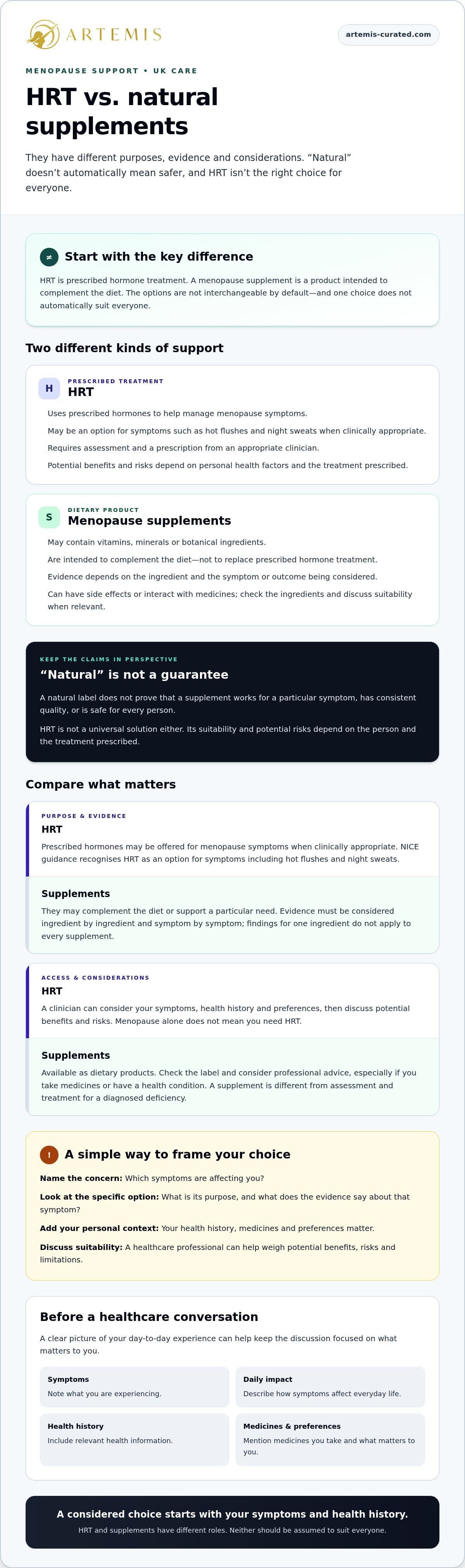
Choosing HRT or Supplements: Questions for Your Doctor
A little preparation can make a menopause appointment more useful. The aim isn’t to diagnose yourself or arrive with a fixed treatment choice. It’s to give your healthcare professional a clear picture of what you’re experiencing and ask how the options may fit your circumstances.
What should you prepare before discussing menopause treatment?
Before your appointment, note when symptoms began, how often they happen and what they make harder in everyday life. Include previous health conditions, current medicines and supplements, and what matters to you in treatment, such as your preferences or concerns. If tests come up, ask what they’re intended to check and whether they’re relevant to your situation.
- Write down your symptoms. Include examples such as disrupted sleep, hot flushes or changes in mood, if you experience them.
- Describe their impact. Note effects on work, rest, relationships or daily routines, and whether symptoms are changing.
- Bring your health and medication history. List relevant conditions and all medicines, vitamins, herbal products and other supplements you take or are considering. If possible, bring the packaging or ingredient information.
- Set out your preferences and questions. Think about what you hope to improve and what concerns you about HRT or supplements.
What questions can help compare your options?
Use the appointment to understand the choices, rather than looking for a single answer that applies to everyone. You might ask:
- Which options could be relevant to the symptoms affecting me, and what benefits might I realistically expect?
- What are the limitations and possible risks of the treatment being discussed, given my health history?
- If we consider HRT, what follow-up should I expect, and when should we review whether it’s helping?
- Could this supplement interact with my medicines or be unsuitable for me? Is there reliable evidence for its ingredients and the symptom I want to address?
- If symptoms persist, change or become harder to manage, when should I seek further advice?
These questions can make the pros and cons of hrt vs natural supplements more specific to you. Advice should come from a qualified UK healthcare professional who can consider your health history and current medicines. If you’re exploring supplements alongside that conversation, browse menopause-support supplements and check the ingredients with your healthcare professional. A supplement shouldn’t replace prescribed treatment.
Where menopause supplements from Artemis Curated fit into the comparison
After considering the evidence and discussing your options with a healthcare professional, you may decide to explore a supplement as part of your personal approach to menopause. Artemis Curated sells The art of harmony, a menopause-support supplement. It doesn’t provide HRT or one-to-one clinical consultations, and the product shouldn’t be treated as a replacement for prescribed treatment.
This distinction matters when weighing the pros and cons of hrt vs natural supplements. A supplement and HRT have different roles. Whether a particular product is suitable depends on its ingredients and your circumstances, including medicines you take and any health conditions. If you’re considering a supplement alongside prescribed treatment, discuss it with your healthcare professional before adding it to your routine.
How can a supplement fit alongside informed menopause care?
Supplement use is a personal choice, not a shortcut around care or a reason to stop prescribed treatment. Keep your clinician or pharmacist informed about what you’re taking, including products you’re thinking about trying. This gives them a chance to consider the ingredients alongside your medication and health history. For a wider view of menopause and the support options discussed in this guide, return to the earlier comparison sections.
What should you check before choosing a menopause supplement?
Start with the product information, not the name or the word “natural”. Read the label to confirm the ingredients and directions rather than assuming what a formula contains. If anything is unclear, seek advice before use. A healthcare professional can help you consider whether the product may be appropriate, especially if you take medication, use other supplements or have a health condition.
- Check the full ingredient list and directions on the product label.
- Share the information with a pharmacist or healthcare professional and ask about suitability or possible interactions.
- Keep track of what you’re taking so you can give an accurate account if your treatment or medicines change.
Artemis Curated offers supplements, including The art of harmony, rather than hormone treatment or clinical advice. If you’d like to review its offerings, explore menopause-support supplements. Read the product information and discuss suitability with a qualified healthcare professional before deciding whether it fits your wider care.
Make your next step an informed one
The clearest takeaway from comparing the pros and cons of hrt vs natural supplements is that they serve different roles. HRT is prescribed treatment, while supplement evidence depends on the ingredient and symptom. Neither is automatically right for everyone, and “natural” doesn’t guarantee a product is safe or effective.
Before deciding, note how symptoms affect your daily life and discuss your health history, medicines and preferences with a qualified healthcare professional. If you’re considering a supplement, review its ingredients and ask whether it’s suitable for you, especially if you take prescribed treatment.
Artemis Curated sells wellness supplements, including The art of harmony for menopause support. It doesn’t provide HRT or clinical consultations, and its supplement isn’t a replacement for prescribed care. To explore the range, discover Artemis Curated’s wellness supplements.
You don’t need to settle every question at once. A thoughtful conversation and a choice grounded in your own needs can help you move forward with greater confidence.
Frequently Asked Questions
Is HRT more effective than natural supplements for menopause symptoms?
For moderate-to-severe menopause symptoms, HRT is generally better supported and more effective, particularly for hot flushes and night sweats, than herbal or dietary supplements. That doesn’t mean it suits everyone or guarantees relief. Evidence for supplements varies by ingredient and symptom, and the Menopause Society’s 2023 position statement did not recommend them for vasomotor symptoms. A healthcare professional can help you weigh the evidence in light of your circumstances.
Can natural supplements replace HRT?
No. Supplements shouldn’t be treated as replacements for prescribed HRT. They’re different types of products, and evidence that a supplement can ease a particular symptom doesn’t show that it can provide the same treatment as HRT. If you’re taking HRT, don’t stop or change it because of a supplement claim. Discuss treatment changes with your prescriber, and ask whether a supplement is suitable for you.
Are menopause supplements safer than HRT because they are natural?
No. “Natural” doesn’t prove that a product is safe, effective or suitable for you. Supplements can have side effects, and some ingredients may interact with medicines or be unsuitable given your health history. Products can also differ in their ingredients and formulation. Read the label carefully and ask a pharmacist or healthcare professional about a specific product, particularly if you take prescribed medicines or have a health condition.
Can you take menopause supplements while using HRT?
Possibly, but check with a pharmacist or healthcare professional before combining them. They’ll need to know the supplement’s ingredients, your HRT and any other medicines or health conditions to consider whether it’s appropriate. Don’t assume a product is compatible because it’s sold over the counter or described as natural. Share the packaging or a full ingredient list, and don’t change your prescribed HRT without speaking to your prescriber.
What are the main disadvantages of HRT?
HRT isn’t suitable for everyone, and it can cause side effects or carry risks that vary with personal health factors and the treatment prescribed. Some people may also prefer not to use hormone treatment. A clinician can explain which considerations apply to you, discuss alternatives and review how treatment is working. There isn’t one risk profile that fits everyone, so avoid making a decision based only on general claims.
What should I ask my GP before choosing HRT or supplements?
To weigh the pros and cons of hrt vs natural supplements, ask which options may address your symptoms, what benefits and limitations to expect, and what risks are relevant to your health history. Tell your GP about all medicines and supplements you take or are considering. Ask whether any ingredients could interact, what follow-up is appropriate, and when to seek further advice if symptoms persist or change.
Do menopause supplements work for everyone?
No. A supplement’s effects can vary by ingredient, product, symptom and individual, and evidence for one ingredient doesn’t establish that every product will have the same effect. Some supplements may not help the symptom you’re hoping to address. Check the product information and discuss its ingredients with a healthcare professional, especially if you take medication. Avoid relying on broad claims that promise the same result for everyone.
0 comments