

Could a herbal remedy offer the same relief as HRT, with fewer concerns? It’s understandable to wonder, especially if you’re thinking about transitioning from hrt to herbal remedies because of side effects, changing needs or a preference for a non-hormonal approach. But “natural” doesn’t automatically mean safer, and herbal options don’t have the same level of evidence as HRT for easing menopause symptoms.
The first step isn’t stopping or reducing your prescribed HRT. Talk with the clinician who manages it about why you want a change, what may happen to your symptoms and whether a gradual adjustment is appropriate for you. Your health history and other medicines matter too, because some herbal products can interact with medication.
This guide will help you prepare for that conversation and understand how the evidence and potential benefits of HRT compare with herbal remedies. It also covers product quality, including the UK’s Traditional Herbal Registration scheme, and ways to track symptoms if your plan changes. A considered discussion is safer than a sudden switch.
Key Takeaways
- Before transitioning from hrt to herbal remedies, identify what’s prompting the change and discuss it with the clinician who manages your HRT.
- HRT and herbal remedies differ in their evidence, intended use and safety considerations. Benefits can vary between remedies and symptoms.
- Prepare for your review by noting your symptoms, treatment history, health conditions, medicines and any supplements you use.
- If you and your clinician agree on a change, follow the plan and track your symptoms so you can review how you’re feeling together.
- Consider menopause supplements only as optional wellbeing support, and discuss ingredients and possible interactions with a qualified healthcare professional.
Considering a move from HRT to herbal remedies? Start with the reason
It’s understandable to have mixed feelings about HRT. It may have brought welcome relief, while side effects, concerns about longer-term use or personal preferences leave you wondering whether to continue. Those feelings can sit alongside each other. You don’t need to make an immediate choice or work it out alone.
Think of transitioning from HRT to herbal remedies as a planned conversation about your treatment, not an automatic switch from prescribed hormones to supplements. HRT decisions depend on your symptoms, health history and treatment goals, so a change that suits someone else may not suit you. Don’t stop, reduce or otherwise alter prescribed HRT without advice from the clinician who manages it.
What is prompting you to consider changing HRT?
Try to separate a concern about a possible side effect from a preference about long-term treatment. Write down what you’ve noticed and when it began. Include which symptoms have improved, persisted or changed since you started HRT. For example, you might be getting fewer hot flushes but still have disrupted sleep, or feel well on treatment while remaining uneasy about continuing it. Uncertainty itself is a valid reason to request a review.
Taking these details to your appointment gives you a clearer starting point. It helps the clinician consider whether your symptoms, treatment and concerns call for a change, rather than assuming a supplement is the next step.
Are herbal remedies a like-for-like HRT replacement?
No. Supplements aren’t automatically equivalent to prescribed hormone treatment. Hormone replacement therapy (HRT) is a medical treatment used for menopausal symptoms. Herbal products have different ingredients and evidence, and the available research can vary by remedy, preparation and symptom. A claim that a product supports wellbeing or a particular symptom isn’t proof that it provides the same benefits as HRT or addresses underlying health concerns.
That distinction matters when weighing your options. A supplement may be something to discuss as part of a wider wellbeing routine, but it shouldn’t be treated as a substitute for prescribed care. Before trying one, share its name and ingredients with a qualified healthcare professional, especially if you take other medicines. For broader context, explore understanding menopause support options alongside a clinician-led review.
You don’t need a final answer before asking for a review. Start with what you’re experiencing and what matters to you. Then discuss the options in light of your own circumstances, rather than relying on a promise that one approach will work for everyone.
How HRT and herbal remedies differ in purpose, evidence, and uncertainty
HRT is a prescribed medical treatment with an established role in easing menopausal symptoms. For people who are suitable candidates, major medical bodies regard hormone therapy as the most effective treatment for these symptoms. Herbal remedies are different: each has its own ingredients, proposed uses and evidence. Results for one preparation can’t be assumed to apply to another.
This distinction matters when weighing the evidence. The Menopause Society’s 2023 position statement did not recommend supplements and herbs for vasomotor symptoms, such as hot flushes and night sweats, because the evidence was insufficient or inconclusive. That doesn’t mean every herb has been studied in the same way. It does mean traditional use, early research and consistent clinical evidence shouldn’t be treated as interchangeable.
| Consideration | HRT | Herbal remedies |
|---|---|---|
| Purpose | Prescribed treatment used to relieve menopausal symptoms. | Products used for a range of purposes; intended effects depend on the specific remedy and preparation. |
| Evidence | An established treatment with a substantial clinical evidence base. | Evidence varies by herb, preparation, symptom and study quality; it may be limited or inconclusive. |
| Safety | Suitability and risks depend on individual health and treatment history. | “Natural” doesn’t guarantee safety. Products can have side effects or interact with medicines. |
What can the evidence say about herbal options?
There isn’t one evidence verdict for all herbal products. A finding about one preparation, taken in a particular way for a particular symptom, can’t establish that other forms or herbs work too. Evidence for one herb can’t stand in for evidence about every herb. In the UK, the MHRA’s Traditional Herbal Registration (THR) scheme assesses registered products for quality and safety. Registration isn’t proof of strong clinical evidence that a product will ease menopause symptoms.
What should readers know about interactions and product claims?
Herbal products can interact with prescribed medicines, and some may not suit particular health histories. St John’s wort, for example, is known to interact with a range of medicines, so mention it and any other supplements you take during a medicines review. The NHS cautions that the effectiveness of many herbal remedies isn’t supported by scientific evidence. Read product information carefully and discuss any supplement with a qualified healthcare professional. For more context on how oestrogen changes during menopause, consider how that information relates to your treatment discussion.
After reviewing safety and suitability with a qualified healthcare professional, a menopause-support supplement may be considered as part of a broader wellbeing routine, not as an HRT replacement. Keep that distinction in mind when exploring menopause-support supplements.
What to discuss before reducing or stopping HRT
If you’re considering transitioning from hrt to herbal remedies, use your HRT review to make a clear, individual plan, not to agree to a change on the spot. Your clinician can consider your symptoms, health history and treatment goals together. There’s no single way to reduce or stop HRT that suits everyone, so don’t change your prescribed treatment without their advice.
Which questions can you take to an HRT review?
It can help to write your questions down beforehand. You might ask:
- What’s prompting a change in my treatment, and which options fit that reason?
- Which symptoms or health concerns should we monitor if my treatment changes?
- Could symptoms return or change, and what should I do if they do?
- When should we arrange a follow-up, and what changes should prompt me to seek medical advice sooner?
Ask about the expected benefits and possible drawbacks of each option, including what the plan would be if your symptoms become difficult to manage. Your clinician can explain whether a change is appropriate for you and how it should be managed. Don’t begin a taper or set your own schedule based on someone else’s experience.
What information should you bring?
A short, accurate record can make the discussion more useful. Gather what you know, even if you don’t have every detail:
- Your HRT history: the type, dose, when and how you take it, how long you’ve used it, and any previous changes.
- Your health background: current or past health conditions and any relevant concerns you want the clinician to consider.
- Everything you take: prescription medicines, over-the-counter products, vitamins and herbal supplements. Bring packaging or a clear list of ingredients where possible.
- Your symptoms: note how often they happen, how severe they feel, their effect on sleep and daily life, and whether they’ve changed over time.
A brief symptom diary can help you describe patterns rather than relying on memory. For example, record night sweats alongside sleep disruption, or note whether hot flushes affect work or everyday activities. Include what has improved as well as what remains difficult.
Before you leave the review, make sure you understand the next step: what, if anything, will change; what you’ll monitor; and when you’ll check in again. If the plan is unclear, ask the clinician to explain it before making a change. A written plan can help you keep track and know when to seek earlier advice.
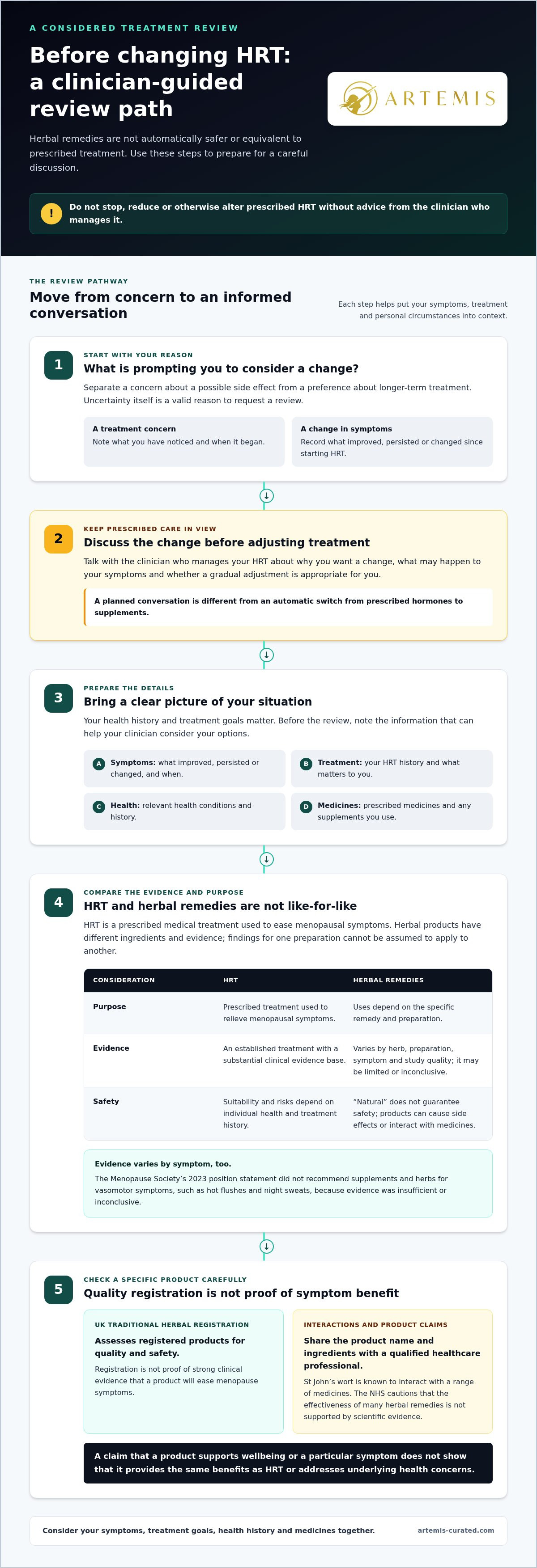
A step-by-step way to monitor a clinician-guided change
A clear plan gives you a way to notice patterns without having to interpret every difficult day on your own. If you’re transitioning from hrt to herbal remedies, the prescribing clinician is the person who can advise on an individual HRT change. Use these steps to support that discussion, not to adjust treatment yourself.
- Prepare: Note your current symptoms, how they affect sleep and daily life, and any medicines or supplements you take.
- Discuss: Review your reasons for considering a change with the clinician who manages your HRT. Ask what to expect, what to monitor and when to follow up.
- Agree on a plan: Make a change only as agreed with your clinician. Write down what will change and when, so you have a clear point of reference.
- Track symptoms: Record symptoms consistently and note when the agreed change began. Look for patterns over time, rather than treating one difficult day as proof that the plan is working or failing.
- Review: Share your notes at the agreed follow-up, or contact your clinician sooner if symptoms worsen or become difficult to manage.
How can a symptom diary make a review more useful?
Keep the record simple enough to maintain. Note the symptom, when it happened, how severe it felt, how you slept and whether it affected work or everyday activities. Choose a straightforward scale, such as low, moderate or high, and use it consistently. Include the date of any treatment change agreed with your clinician. These notes can reveal a pattern, but they aren’t a reason to alter your HRT without advice.
You don’t need to record every detail of your day. A few consistent notes can be more useful than a long account that’s hard to keep up. Bring the diary to your review and discuss what you’ve noticed, including symptoms that improved as well as those that returned.
What if symptoms return or a supplement causes a concern?
If symptoms worsen or become difficult to manage, contact the clinician responsible for your HRT and ask what to do next. Don’t change your prescribed treatment on your own. If you develop a concerning reaction after taking a non-prescribed supplement, stop taking it and seek medical advice. In the UK, NHS 111 can help if you need urgent advice and aren’t sure where to turn; call 999 for a life-threatening emergency.
After a supplement has been reviewed for suitability and possible interactions, it may be considered as optional wellbeing support, not a replacement for HRT. If it’s relevant to your wider routine, explore menopause-support supplements with your clinician’s advice in mind.
Where menopause supplements may fit after an HRT discussion
A menopause supplement may have a place in your wider wellbeing routine, but it isn’t a substitute for HRT or clinical care. If you’re considering transitioning from hrt to herbal remedies, keep those decisions separate: a supplement shouldn’t determine whether or how you change prescribed treatment. That plan belongs with the clinician who manages your HRT.
How to consider a menopause supplement responsibly
Before taking a product, read the full ingredient list and serving directions. Share them with a qualified healthcare professional, along with a list of your medicines, other supplements and relevant health conditions. This lets them consider possible interactions or reasons the product may not be suitable for you. Don’t assume a product is safe simply because it’s described as natural.
In the UK, the MHRA advises consumers to look for a Traditional Herbal Registration (THR) mark on herbal remedies. THR relates to quality and safety based on traditional use; it doesn’t show that a product has been proven to work as well as HRT or to treat a medical condition. Be cautious of claims promising guaranteed results, “hormone balancing” or an equivalent effect to prescribed treatment.
The art of harmony is Artemis Curated’s menopause-support supplement. Consider it only as an optional part of a broader wellbeing routine, after reviewing its ingredients and suitability with a qualified professional. It isn’t an HRT replacement, and no particular result should be assumed.
A gentle next step for ongoing menopause support
You don’t need to decide everything at once. Keep your HRT plan clinician-guided, take time to review any supplement you’re considering, and note questions to raise at your next appointment. For wider context, read a broader guide to menopause support as you consider which options may be relevant to your needs.
If you’d like to learn more about menopause support supplements, use that information to help you consider your options, not as a prompt to change treatment. Any HRT decision should be made with your clinician.
Choose your next step with care
Changing menopause treatment deserves time and a clear plan. Before transitioning from hrt to herbal remedies, discuss your reasons, symptoms and health history with the clinician who manages your HRT. Don’t stop or adjust prescribed treatment without their advice.
Herbal supplements aren’t automatically equivalent to HRT, and evidence and safety can vary between products. If you’re considering one, review its ingredients and directions with a qualified healthcare professional, especially alongside your medicines. A symptom diary can help you and your clinician spot patterns and decide when to review the plan.
For optional wellbeing support, The art of harmony is Artemis Curated’s menopause-support supplement, alongside a wider range of targeted wellness supplements. It isn’t a replacement for HRT or clinical care, and it’s sensible to discuss suitability before use.
Explore menopause support supplements from Artemis Curated, and discuss any supplement or HRT change with a qualified healthcare professional.
Frequently Asked Questions
Can I stop HRT suddenly and switch to herbal remedies?
Don’t stop or change prescribed HRT without first speaking to the clinician who manages it. Whether to stop, reduce or continue depends on your symptoms, health history and treatment goals. Herbal remedies aren’t automatic replacements, and symptoms may return or change after stopping. If you’re considering transitioning from hrt to herbal remedies, discuss your reasons and possible next steps with your clinician before making any change.
Are herbal remedies as effective as HRT for menopause symptoms?
No evidence supports treating herbal remedies as equivalent to HRT. HRT is an established treatment for menopausal symptoms, while evidence for herbal products varies by the specific herb, preparation, symptom and quality of research. The Menopause Society’s 2023 position statement did not recommend supplements and herbs for vasomotor symptoms because the evidence was insufficient or inconclusive. Discuss suitable options with a qualified clinician rather than relying on product claims alone.
Which herbal remedies are used for menopause symptoms?
Products marketed for menopause may contain black cohosh, red clover, sage or soy isoflavones, among other ingredients. Their evidence and safety aren’t interchangeable, and a product’s use or traditional status doesn’t prove that it will ease your symptoms. In the UK, the MHRA advises choosing herbal remedies with a Traditional Herbal Registration (THR) mark, which relates to quality and safety, not proof of strong clinical benefit.
Can herbal remedies interact with HRT or other medicines?
Yes. Herbal remedies can interact with prescribed medicines, including potentially affecting how a medicine works. St John’s wort is a known example of an herb that interacts with a range of medicines, so don’t use it as a menopause treatment without professional advice. Before starting any supplement, share its full ingredient list with a qualified healthcare professional and tell them about your HRT, other medicines and health conditions.
Do I need to taper off HRT before stopping?
There isn’t one tapering approach that suits everyone. Your prescriber can advise whether to reduce HRT gradually or stop in another way, taking account of your treatment and circumstances. Symptoms can return after stopping, whether you taper or stop, so agree in advance how you’ll monitor them and when to follow up. Don’t create your own schedule or copy another person’s plan.
What should I track when changing menopause treatment?
Keep a simple diary of symptom type, timing and severity, along with sleep and effects on daily activities. Use the same rating scale each time, such as low, moderate or high, and note when a clinician-agreed treatment change begins. Include improvements as well as difficulties. Share the pattern with your clinician at follow-up, and contact them sooner if symptoms worsen or become hard to manage.
Can I take menopause supplements while using HRT?
Possibly, but check with a qualified healthcare professional before combining a supplement with HRT. Suitability depends on its ingredients, your medicines and your health history, since supplements can interact with treatments. Read the full ingredient list and serving directions, and bring them to your review. A menopause supplement may be considered as optional wellbeing support, but it shouldn’t replace prescribed HRT or clinical care.
0 comments